“Healing Tips for the Mind, Body, and Soul” is the top Sunbury bestseller for January

From Blue Ground is moving up on the Best Seller List on Sunbury Press!

SummaSys's avatarSUNBURY PRESS BOOKS

MECHANICSBURG, Pa. — Sunbury Press has released the bestsellers list for January, 2016. Dr. Arif Shaikh took the top spot with his compilation of 365 tips for personal growth Healing Tips for the Mind, Body, and Soul. John E. Wade II’s Bipolar Millionaire took the #2 spot.

SUNBURY PRESS – Bestsellers for January, 2016 (by Revenue)
RankLast MonthTitleAuthorCategory
1Healing Tips for the Mind, Body, and SoulDr. Arif ShaikhSelf-Help
2NEWThe Bipolar MillionaireJohn E Wade IIBiography
36Capital MurderChris PapstInvestigation
4IonicaCatalina PetcovBiography
5NEWChoice of EnemiesM A RichardsSpy Thriller
6The Savage ApostleJohn KachubaHistorical Fiction
714Jesus the PhoenicianKarim El KoussaHistory
811The Penns’ Manor of Spread Eagle and the Grist Mills of the Upper Mahantongo ValleySteve TroutmanHistory
910

View original post 818 more words

Brother and sister flee with mysterious blue stone from coal mine — authorities in pursuit

SummaSys's avatarSUNBURY PRESS BOOKS

POTTSVILLE, Pa.  — Sunbury Press has released From Blue Ground, Joe Harvey’s historical YA novel about a brother and sister trying to solve the mystery of their late father’s murder.

fbg_fcSet in 1876 in the coal hills of Pennsylvania, the story follows two unwitting orphans, Patrick and Sissy Hughes, who are propelled on a desperate journey after witnessing the murder of their father. They carry with them a wooden box retrieved from a secret compartment beneath their father’s bed. His dying words to them: “keep it safe, keep it hidden.” Powerful men are looking for what’s inside the box and they will do anything they can to get it.

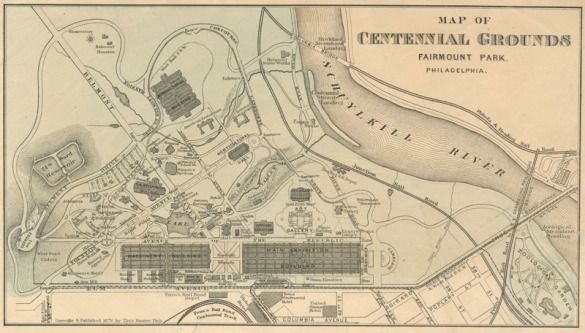
One hundred miles to the South, large crowds have gathered at the Centennial Exhibition in Philadelphia. Patrick and Sissy’s father had promised to take them there for the Fourth of July celebration. Instead, they are running for their lives. Alone…

View original post 725 more words

The Main Exhibtion Building

This is the Main Exhibition Building from Philadelphia’s 1876 Centennial Exhibition depicted in Chapter 19 of From Blue Ground. 

Main Building

CentennialExhibition_MainBuilding-e1354991704100-575x351

The Main Building measured 1880 by 464 feet, covering twenty acres. It was vividly painted inside and out in shades of buff, architectural details picked out in green bronze and gold, crimson, pearl, and several shades of green.

Inside, the center had a high ceiling with four towers connected by stairs, bridges, and one technological advance: an elevator. Fountains, which were not only aesthetic, but performed the function of cooling the air, separated the corridors.

Source:  The Encyclopedia of Philadelphia

The 1876 Centennial Exhibition

Centennial-11423-F-6

From the University of Delaware Website…

The 1876 Philadelphia Centennial Exposition, the first exposition of its kind in the United States, was held to mark the 100th anniversary of the Declaration of Independence. It celebrated not only a hundred years of American independence, but also the country’s recovery from Reconstruction and its emergence as an internationally important industrial power.

Ten years in the planning, the Centennial Exposition cost more than eleven million dollars and covered more than 450 acres of Philadelphia’s Fairmount Park. More than ten million visitors visited the works of 30,000 exhibitors during its six month run. The focal point of the exposition was Machinery Hall, where visitors could marvel at the engineering wonders of the age: electric lights and elevators powered by the 1,400-horsepower Corliss steam engine, locomotives, fire trucks, printing presses, mining equipment, and magic lanterns. Introduced to the public for the first time were typewriters, a mechanical calculator, Bell’s telephone, and Edison’s telegraph. These and thousands of other artifacts became the basic collection of the new Arts and Industry Building of the Smithsonian Institution.

The other major attractions were the Main Building, devoted to manufactures of the U.S. and other countries; Memorial Hall, dedicated to the fine arts; and Horticulture Hall, a conservatory for the display of native and exotic plants. Everything at the Centennial was classified by department (Mining and Metallurgy, Manufactures, Education and Science, Art, Machinery, Agriculture, and Horticulture), and further in a logical scheme that later became a model for the Dewey Decimal System.

The greatest impact of the Centennial Exposition was on the image of the United States. Before 1876 Europe had generally considered the U.S. an upstart country, not yet quite eligible to join the ranks of first-class nations. In this country, Americans had come through a difficult period; the post Civil War years were marked by political scandal and lack of leadership. Visitors and businessmen from abroad were astonished at America’s industrial productivity, its creativity, and its progressiveness. The country was hailed as the land of progress and increasing economic power. The Centennial gave Americans pride in the present and confidence in an even greater future.

The Centennial was an opportunity for the United States to highlight its industrial and agricultural products. The Country was just beginning to look towards a global economic presence. Representatives from other nations who came to display their own products also had an opportunity to see what they might purchase from American firms. Various states also were represented at the fair. Delaware, for example, emphasized its potential for economic development by describing its towns, transportation, and educational facilities.

Reprinted From the University of Delaware Website…

http://www.lib.udel.edu/ud/spec/exhibits/fairs/cent.htm

For more information about the Exhibition, click here.

Available now!

FBG7

It’s the eve of Independence Day 1876, and Patrick and Sissy are running for their lives. Their only hope lies in unlocking the mystery of a stone that emerged From Blue Ground

Patrick and Sissy Hughes are fleeing their father’s murderer.  They carry with them a wooden box retrieved from a secret compartment beneath their father’s bed.  His dying words to them: “keep it safe, keep it hidden.”  Powerful men are looking for what’s inside, and they will do anything they can to get it.

Set in 1876 in the coal hills of Pennsylvania, From Blue Ground follows the two unwitting orphans as they make their way to Philadelphia, where large crowds have gathered at the Centennial Exhibition.  Their father had promised to take them there for the Independence Day celebration.  Instead, they are running for their lives.  Alone and on the run, they are pursued by James McKenna, their father’s murderer, a rogue Pinkerton Security Agent working undercover for the Philadelphia and Reading Railroad.

Patrick and Sissy’s only hope is to unlock the mystery of the contents of the box: a diary, a translucent blue stone, and a bag of blue ground.  As they make their way to Philadelphia, their pursuers grow in numbers and Patrick and Sissy must fight against time and the odds to stay together—and alive.

Available for purchase at the retailers below!

Screen Shot 2016-01-10 at 4.37.54 PM

buy3._V192207739_

Screen Shot 2016-01-10 at 4.36.17 PM


Massacre at Wiggans Patch

The opening scene in From Blue Ground was inspired by this historical event…

Dark shadows continue to follow murder of 134 years ago

People say there is no rest at Wiggans Patch, where time hasn’t healed.

The wild story of what happened there and the injustice that followed might be shrugged off by some as simply unbelievable, except for the fact that it’s true.

Said to be Schuylkill County’s most haunted site, Wiggans Patch continues to feel reverberations even after 134 years. Time hasn’t erased images of the horrific bloodshed in the middle of the winter night.

It was the evening of Dec. 9, 1875.

Ellen O’Donnell McAllister lived at 140 Main Street in Wiggans Patch, now called Boston Run, about 14 miles northeast of Tamaqua. She was 20 and pregnant.

Ellen and husband Charles stayed with Ellen’s mother in the large wood-frame duplex situated atop the knoll just beyond Mahanoy City. Also living there were Ellen’s two brothers, one named Charles, the same as Ellen’s husband.

Life was tough for the hardworking family. Money was scarce.

Worse yet, it was a time of labor unrest and turmoil in northeastern Pennsylvania, a situation that impacted the O’Donnell family. The O’Donnells were suspected of being members of the reputed Molly Maguires, a band of Irish immigrant coal miners accused in a string of murders and assaults throughout the southern coalfields.

To be exact, Ellen’s brothers had been implicated in the September 1 killings of mine boss Thomas Sanger and miner William Uren at Raven Run. If that weren’t enough, some said Ellen’s brother-in-law, James McAllister, was an accomplice.

There was an obvious connection linking the O’Donnells to the Mollies. Ellen’s sister, Mary Ann, was married to Black Jack” Kehoe, a Girardville innkeeper known as King of the Mollies.

It was guilt by association. Nothing had been proven. But Ellen lived during a complicated period in American history. There had been countless murders in a reign of terror throughout eastern Pennsylvania’s coalfields. The public was worried and frenzied. Whether right or wrong, the strong links to the Mollies were enough to cast suspicion over the O’Donnell crew.

To be a Molly was to be bad, according to what folks said and wrote back then.

But there are two sides to every story. Today, some see things differently.

Many say the Mollies, themselves, were wrongly accused. In many ways, they may have been victims of circumstance, targets of anti-Catholic prejudice. They might have been framed. Some say they might even be hailed as heroes today for advocating workers’ rights.

These repressed laborers had fled Ireland’s potato famine to come to the land of opportunity. But instead of bettering their lot, they found themselves toiling deep in the bowels of dark, dank coal tunnels. Long hours of sweat produced little pay. There was no such thing as upward mobility except for each day’s vertical climb out of the dangerous black hole.

Perhaps the Mollies rebelled, as many say. But if they did, maybe their antagonistic push for better working conditions was well intended. Perhaps their cause sparked the rise of America’s organized labor movement.

But on this day, the only labor that concerned Ellen was the physical stress of her upcoming childbirth.

Historical accounts clearly describe what happened on the cold December night.

Ellen’s mother, Margaret, a widow, was the last to go upstairs to bed. Grannie,” as they called her, had just finished putting coal on the stove to keep the house warm. She knew that Ellen’s pregnancy was coming along fine. But naturally, Grannie didn’t want her daughter to catch a chill.

All was peaceful for a few hours as the stroke of midnight changed December 9 into December 10.

Then, about 1 a.m., Ellen was awakened by a strange noise, a very intense rustling and crunching. It sounded as if hordes of people were stomping on top layer of fallen leaves. Ellen nudged hubby Charles, asking him to investigate.

Before anybody could react, a small army of about 20 armed, camouflaged men kicked in the door, roared into the house and began firing. Ellen’s brother Charles was dragged out of the house by the invaders. His body was riddled with 18 bullets.

Her other brother escaped. James McAllister was found in the house, too. The vigilantes grabbed him and put a noose around his neck. But when they dragged him outside, James somehow managed to wiggle free and flee into the dark woods.

Seeing what was happening at the front of the house, Ellen’s husband jumped out a back window and disappeared into the night, chased by a few of the gunmen. Grannie was pistol-whipped but still alive.

By this time Ellen had put on her robe, made her way down the dark stairway to see what the ruckus was all about. She appeared at the front door to catch a glimpse of the goings-on. Several assailants turned, looked at her, and fired point blank.

Ellen’s eyes rolled as she reached for her stomach with her right hand. With her left arm she tried in vain to deflect the siege of bullets.

My baby,” she screamed. Oh dear God, my baby!” Ellen cried out, blood trickling from the corner of her mouth.

She gasped, faltered, and clung to the doorframe for a few seconds. But her strength quickly faded and she crumpled to the floor.

Seeing what they had done, the gunmen ran, scattering in all directions.

The bitter air grew silent. Sweet Ellen McAllister, her precious unborn child and her brother had become three more victims of man’s inhumanity toward man.

The news spread fast when, a few days later, Ellen’s body and that of her brother were taken to Tamaqua by train. Upon arrival, the corpses were packed in ice and stored overnight in the train station to await burial at old St. Jerome’s Cemetery.

The massacre rocked the region. Police searched for the perpetrators.

Theories abounded as to what really had happened. Some believed the ambush had been orchestrated by the Coal and Iron Police or even the Pinkerton Detective Agency. Some suggested a militia unit from Mahanoy City had done it. No arrests were made. Nobody ever was charged.

For Ellen McAllister, her baby and her brother, there was no justice. And no eternal rest.

In fact, many believe Ellen’s spirit roams Wiggans Patch. Energized by her strong will to live and give birth, she supposedly drifts through the site in her nightclothes. They say she waits for morning, for the eternal nightmare to end, so that she can give birth to her child in peace. Ellen’s due date was the day after she was murdered.

The haunting can be felt at night. The pleas from the house are like a low moaning sensation as if she’s saying ‘help me, help my baby,'” said Deborah Randall, a Washington, D.C., playwright who investigated the murders several years ago while doing research on the Mollies.

But the unrest doesn’t end there.

On Nov. 17, 2006, the house long a spectacle and a destination for the curious was quietly torn down. Officials say the walls had begun to bulge. The house, which had been situated on land owned by the Reading Anthracite Company, had became lopsided, they said. It began to lean dangerously, threatening to topple onto the adjacent roadway and power lines.

There was a drive mounted to preserve the structure but the building was torn down before the effort picked up steam.

Then came another odd development. Last year, the site was nominated but then officially turned down to receive a state historical marker. It seems the state is having difficulty in identifying the relevance of the Massacre site and how it plays into the story of the Mollies.

It seems there are forces that want to forget about what took place at Wiggans Patch.

Some may try to discredit it, or wish it would go away. But the Wiggans Patch Massacre will remain a reality in the history of Pennsylvania, in the rise of organized labor, and in the saga of the Molly Maguires.

But above all, it sadly remains a story without an ending. There was no justice. There were no trials. Nobody was ever caught and convicted.

Today, it is still possible to see the cellar area and remnants of foundation walls at the site along Route 54. But nature is quickly reclaiming the land.

Earlier this year, members of the Pennsylvania Paranormal Research Team, Schuylkill Haven, investigated the foundation area and declared it haunted. While researching, members say they were approached by the spirit of a little boy who asked to go along home with them.

Who was the little boy? Was he the spirit of Ellen’s unborn child? Or was the voice actually that of Ellen herself?

Some believe the shock of the murderous raid, an unbelievable horror, has trapped Ellen’s spirit at Wiggans Patch. She was an innocent housewife who didn’t deserve her fate. For her, time is standing still.

They say she cries out each night for the bullets to stop.

Ellen McAllister cries out for peace.

Source: Massacre at Wiggans Patch

From Blue Ground is available for purchase at the retailers below!

Screen Shot 2016-01-10 at 4.37.54 PM

buy3._V192207739_

Screen Shot 2016-01-10 at 4.36.17 PM


Handyman witnesses a murder in Connecticut’s Litchfield Hills

Read an excerpt from Murder Run!

SummaSys's avatarErnest & Edgar Literary Blog

LITCHFIELD, Conn. — Sunbury Press has released Murder Run, Shelly Frome’s latest murder mystery, set in the Litchfield Hills of Connecticut.

mr_fcIn this crime novel, a wayward handyman grapples with the suspicious death of his employer, a fragile choreographer who secluded herself in the Litchfield Hills. As the fallout mounts, the reader is taken to various locales in and around Manhattan, an escapade in Miami Springs and back again to the hills of Connecticut until this twisty conundrum is finally laid to rest.

EXCERPT:
Jed turned around and headed back for the cellar. Banging into things, he brushed past the mess the guy had made, located the breaker panel, flipped the switches, and climbed the stairs as the lights came back on. He called her name as he passed the kitchen and cut around the dining room, but there was no answer.

He hurried up to the bedroom and…

View original post 376 more words

El Koussa’s books reign in advance of his upcoming US Tour — Sunbury Press bestsellers for August

SummaSys's avatarSUNBURY PRESS BOOKS

MECHANICSBURG, Pa. — Sunbury Press has released the bestsellers list for August, 2015. Karim El Koussa took the top two spots with Jesus the Phoenician and Pythagoras in anticipation of his upcoming US Tour. Ron Knorr and Clemmie Whatley’s The Segregated Georgia School for the Deaf moved up to 3rd, while Chris Papst’s Capital Murder, the prior top bestseller, slipped to 4th.

SUNBURY PRESS – Bestsellers for August, 2015 (by Revenue)
RankLast MonthTitleAuthorCategory
1Jesus the PhoenicianKarim El KoussaReligious History
2PythagorasKarim El KoussaHistorical Fiction
38The Segregated Georgia School for the DeafRon Knorr & Clemmie WhatleyHistory
41Capital MurderChris PapstInvestigation
57Where Elephants FoughtBridget SmithHistorical Fiction
63The Bipolar Millionaire and the OperationJohn E Wade IIMemoir
76The B TeamAlan MindellSports Fiction
8

View original post 827 more words